Table of Content
How do transparent screens work, and how can they fit into your digital signage strategy? These displays use specialized OLED, LED, or LCD technology to overlay dynamic digital content onto glass surfaces without blocking the view, creating a modern, high-tech look for retail windows, museums, and corporate offices.
The market for transparent displays is expanding rapidly. Forecasts suggest significant growth through 2026 and beyond, driven by the unique ability of these screens to blend digital messaging with physical environments-offering a sleek alternative to traditional "black box" monitors.
What are transparent screens?
How do transparent displays work?
Transparent displays work by shaping light rather than blocking it. While a standard screen relies on a solid back layer that obstructs vision, a transparent screen uses materials and pixel structures designed to let you see through the panel. In technologies like OLED, each pixel generates its own light and sits on a clear substrate, such as glass or specialized plastic. When a pixel is turned off, it becomes transparent, behaving much like a standard window.
Engineering these screens involves overcoming the visibility of wiring. Traditional electronics use solid metal wires, which would clutter the view. To solve this, manufacturers use microscopic wiring patterns or clear conductive materials like Indium Tin Oxide (ITO). These deliver power to the pixels without creating a visible grid. The result is content that appears to float in mid-air-a visual effect that captures attention immediately.
What sets transparent screens apart from traditional displays?
The primary difference is that a transparent screen keeps your space open. Traditional displays act as solid barriers; when turned off, they are simply dark rectangles that can disrupt the flow of a room. Transparent screens preserve lines of sight and natural light, even while displaying content. This allows for "ambient augmentation," where digital information layers seamlessly over real-world objects.
These screens also provide a distinct advantage in high-traffic areas like malls or trade shows. Because they often lack bulky backlights or opaque housings, they can be integrated directly into windows, glass partitions, or curved surfaces. This allows designers to treat the display as part of the architecture rather than just an added piece of hardware.
Which transparent screen types are available?
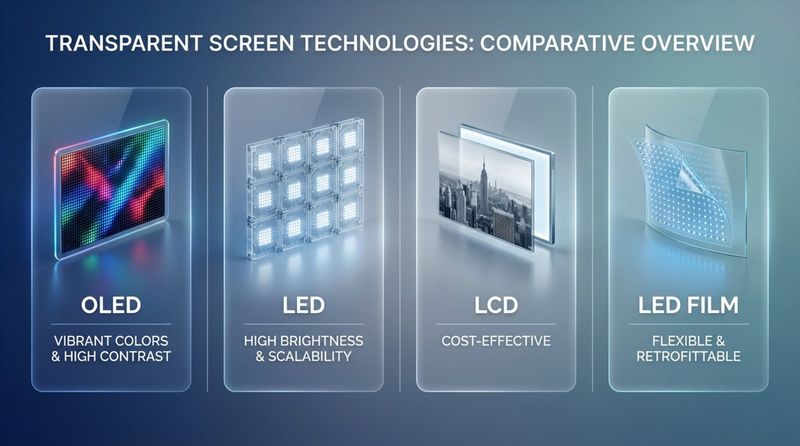
Transparent OLED screens
Transparent OLED (Organic Light Emitting Diode) is typically the preferred choice for indoor environments requiring high-quality visuals. Since OLED pixels are self-emissive, they require no backlight, allowing for incredibly thin profiles and transparency rates often exceeding 40-45%. Major manufacturers like LG are leaders in this space, providing panels known for sharp contrast and vibrant colors.
In a Transparent OLED (TOLED) display, black content appears transparent because the pixels simply turn off. This makes TOLED ideal for luxury retail and museum cases, where the physical product behind the glass needs to remain the star. However, these screens generally perform best in controlled lighting conditions rather than direct sunlight.
Transparent LED screens
Transparent LED systems are the standard for large-scale implementations. These use LEDs mounted on clear mesh or thin strips. Because the LEDs are spaced out, the human eye blends the light into a cohesive image from a distance, while the gaps allow for visibility through the screen. These units are capable of high brightness-often between 1,000 and 6,000 nits-making them the right choice for storefront windows and semi-outdoor spaces.
LED systems are durable and energy-efficient. Their modular nature allows you to connect multiple panels to cover expansive areas, such as entire building facades, without completely blocking the view from the inside. This is often referred to as "media architecture."
Transparent LCD screens
Transparent LCD (TLCD) adapts traditional Liquid Crystal Display technology for see-through applications. Unlike OLEDs, LCDs do not produce their own light; they require an external light source to make content visible. This light can come from ambient sunlight or internal case lighting. While often more affordable than OLED, the visuals can appear washed out if the lighting conditions aren't optimized.
Despite this, TLCDs can achieve high transparency (up to 70% in some cases) and are frequently used in smart display boxes. For example, a jewelry display might use a transparent LCD front to show pricing and product details, while the actual item sits illuminated inside the box.
Transparent LED display film
A flexible and innovative option is Transparent LED display film. This is a thin, self-adhesive sheet-often just a few millimeters thick-with LEDs embedded within it. It can be applied directly to existing glass surfaces. The film is flexible enough to wrap around curved windows or columns, making it highly versatile.
This solution is excellent for retrofitting. Instead of replacing an entire window with a heavy display cabinet, you can simply apply the film to the glass. It can often be cut to size, offering a level of customization that rigid screens cannot match.
Key features and specifications of transparent screens
Transparency levels and brightness
Performance balances visibility of the content with visibility of the background. LED films usually offer transparency ranges from 60% to 95%, while OLEDs typically sit around 40-50%. Higher transparency lets more light through but provides less surface area for pixels.
Brightness is crucial for visibility. For standard indoor use, 500-2,000 nits is generally sufficient. However, for street-facing windows, you will likely need "semi-outdoor" models rated at 4,000-6,000 nits to ensure your content remains readable against sunlight.
Touch and interactive capabilities
Many transparent displays integrate capacitive or optical touch sensors, turning the glass into an interactive surface. This allows users to tap on a window to browse product catalogs or explore details about an exhibit. To manage this interactivity, software like Look Digital Signage supports Interactive Scenarios, allowing you to build touch-based experiences without complex coding.

Size, resolution, and form factors
Transparent OLED panels often come in fixed sizes like 30", 55", and 77", supporting Full HD or 4K resolutions. Transparent LED displays are more modular, allowing you to build custom sizes by linking panels. Common form factors include:
- Freestanding kiosks and totems
- Ceiling-suspended displays
- Integrated cabinet or shelf screens
- Retractable systems that hide the screen when not in use
Mounting and installation options
Installation flexibility is a key benefit. Common setups include:
- Freestanding plinths: Popular in showrooms and galleries.
- Ceiling-mounted systems: keeps floor space clear and maintains an open feel.
- Desk-mounted units: Useful for reception areas or service counters.
- Glass-integrated solutions: Embedded directly into walls, doors, or partitions.
Benefits of using transparent screens
Boosting customer engagement and immersion
Transparent screens merge digital storytelling with physical reality. In retail, a screen can overlay animations that highlight specific features of a product-like materials or internal mechanics-sitting right behind the glass. This layered approach is often more engaging and memorable than standard printed signage.
Saving space and improving aesthetics
Because these displays function as both a window and a screen, they eliminate the need for bulky monitors that take up floor space. This is ideal for compact environments like boutique stores or crowded lobbies. The clean, "invisible" design ensures the display doesn't clash with the interior decor when it's not running content.
Supporting creative and flexible content
These displays offer unique creative possibilities. You can design graphics that interact with the background, such as virtual labels floating over specific parts of a car engine. To manage this effectively, Look Digital Signage is a strong fit. Using the Look CMS, you can utilize Screen Layouts to position content precisely where it needs to be on the glass, ensuring digital elements align perfectly with the physical objects behind them. This allows you to update campaigns remotely from anywhere, without needing to physically rearrange your display.
Common use cases and industry applications
Transparent screens in retail and advertising
High-end retailers use transparent screens to stop passersby in their tracks. Motion graphics can play on a storefront window while still allowing a clear view into the store. Interactive mirrors are another growing trend, letting customers "try on" accessories digitally while seeing their own reflection.

Hospitality and entertainment applications
Restaurants and hotels use these screens to modernize their spaces without blocking views. Automated pickup walls with transparent LCD fronts allow customers to see their food while reading order names on the glass. Sports bars can overlay scores and stats on windows without obscuring the street view.
Display solutions for museums and exhibitions
Museums utilize transparent screens to provide context without touching fragile artifacts. A display can overlay historical timelines or 3D reconstructions over a physical relic. Using Look CMS, curators can schedule different information loops to accommodate different tour groups or languages.
Automotive industry uses
Showrooms use transparent displays to create "smart barriers" around vehicles, displaying technical specs and pricing. The technology is also moving into the cars themselves, with Heads-Up Displays (HUDs) projecting speed and navigation data onto the windshield to keep the driver's eyes on the road.
Healthcare and medical environments
In surgical settings, transparent screens allow medical teams to view vital signs and imaging data without looking away from the patient. This helps streamline workflows and maintains a clear line of sight in the operating room.
Corporate and architectural installations
Offices use transparent displays for meeting room glass walls. These can switch from clear to opaque for privacy, or display room booking schedules and company dashboards. Using Look Digital Signage, these screens can be connected to internal calendars to show real-time availability.
Considerations when choosing a transparent screen
Transparency rate and visual clarity
You must balance clarity with image strength. A high transparency rate (e.g., 85%) keeps the view open but may result in fainter images. A lower rate (around 40%) provides better contrast for your content but behaves more like tinted glass.
Lighting conditions and ambient brightness
Ambient light is a critical factor. In bright environments, OLED visuals can appear washed out. It is important to match the screen’s brightness to the location. For semi-outdoor use, prioritize high-brightness LED options (4,000+ nits) to ensure visibility.
Interactive versus non-interactive options
Decide early if you need touch capabilities. Adding interactivity increases cost and complexity but drives higher engagement. If you do choose touch, ensure your software supports it. Look Digital Signage is designed to handle interactive content, making it easier to deploy functional kiosks or catalogs.
System integration and content management
A transparent screen is only as reliable as the system running it. You need a robust media player and software to manage playback. The Look HDMI Player is a plug-and-play hardware option that works seamlessly with most displays. Combined with the Look CMS, you can manage content remotely, use Smart Scheduling to change messaging by time of day, and ensure your visuals are always rendering correctly.
Long-term maintenance and support
While durable, LED components can occasionally fail. Modular designs are advantageous because they allow you to replace specific sections rather than the entire unit. Look for manufacturers that offer solid warranties and support.
Popular manufacturers and brands for transparent screens
LG: innovation and product offerings
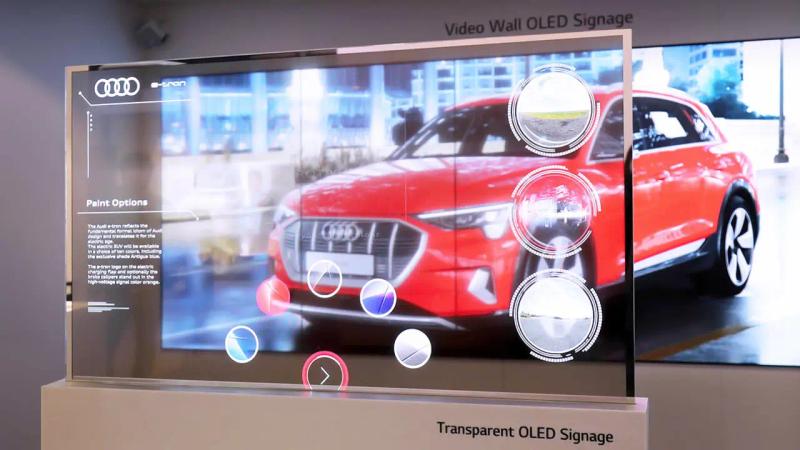
LG is a dominant force in the transparent OLED market. Their 55" FHD Transparent OLED Touch panels are a staple in retail and corporate projects, known for their premium build quality and high transparency.
Leyard and Planar: flagship solutions
Leyard and Planar are key players in the high-end display sector. Their solutions are frequently found in museums and corporate HQs, offering sleek glass designs with optimized light transmission.
Miqidisplay and other notable brands
Miqidisplay brings decades of experience in custom display projects, adhering to strict industrial standards suitable for medical and specialized sectors. Other manufacturers like Samsung and Muxwave also provide competitive solutions, particularly in the realm of high-brightness films and holographic screens.
Challenges and limitations of transparent screens
Performance in bright environments
Sunlight remains the biggest challenge. Glare can wash out content on even the best screens. Some installations mitigate this by using anti-reflective coatings or installing retractable dark backgrounds that can be deployed when higher contrast is needed.
Limited color accuracy or contrast
Since transparent screens lack a pure black background, colors may not appear as saturated as they do on standard TVs. Black content typically renders as transparent, meaning you cannot display "black" colors-you simply reveal the background.
Cost factors and return on investment
These displays require a higher initial investment than standard signage. However, their ability to stop traffic and engage customers can drive a faster ROI. To track this, Look Digital Signage offers Playback Analytics, giving you data on content performance to help you optimize your strategy.
Future trends in transparent screen technology
Latest innovations and research
Technology is moving toward Transparent MicroLED, which promises even higher brightness and durability than current OLEDs. "Holographic" invisible screens are also in development, aiming for near-perfect clarity when the display is inactive.
Predicted changes in adoption and capability
As production costs decrease, transparent screens will likely become common in everyday environments, from public transit windows to home appliances. Integrated with AI and faster networks, these screens will deliver real-time, context-aware information to users seamlessly.
Conclusion: The shift toward integrated media
Transparent screens represent a move toward "integrated media," where digital information lives within our physical environment rather than on separate, distracting devices. Whether you are upgrading a retail window or modernizing a corporate office, the key to success lies in pairing the right hardware with reliable management software. With tools like Look Digital Signage, you can control these advanced displays from a simple dashboard, ensuring your content is always fresh, scheduled, and running smoothly.