Table of Content
In 2019, LG unveiled the first commercially available rollable TV, successfully achieving a technological feat the world had never seen before. The 65-inch Signature OLED R was priced at $100,000, later reduced to $87,000. When you pressed a button, this ultra-thin OLED screen would unfurl from an aluminum base cabinet in about 10 seconds, telescoping arms keeping it rigid as it rose.
LG gave it three modes: Full View showed you the complete 65-inch display, Line View let you partially extend it to show a clock or music controls, and Zero View tucked everything away, leaving just the base with its 4.2-channel Dolby Atmos sound system. Picture quality was good(though arguably nothing exemplary compared to other cheaper options), matching LG's high-end C-series OLEDs with 120Hz refresh rates, VRR for gaming, and 4K resolution.
Despite the technological achievement, LG discontinued the Signature OLED R in 2024 after five years of dismal sales. They sold very few units, closed the production line in late 2023, and even pulled the demo units from retail stores. The company never managed to bring down production costs during its five-year run, and the 2021 updated version did little to persuade customers.
So was it a complete failure? Not exactly. LG proved that OLED panels could roll and unroll about 100,000 times without breaking. The technology worked, but the business case didn't. And that's an important distinction, because while the rollable TV itself failed commercially, the technology behind it is now showing up in laptops, smartphones, and car dashboards.
What Are Rollable Displays and How Do They Work?
A rollable display is exactly what it sounds like: a screen that can roll up. Instead of being mounted on rigid glass like your typical TV, these displays use ultra-thin OLED panels on flexible plastic substrates, usually polyimide. They can smoothly wind around a cylinder mechanism, changing size without creating the visible creases you see on foldable phones.
The Core Technology is Innovative
Why OLED? Regular LCD screens need a backlight, which requires rigid components. But in OLED technology, each pixel emits its own light. This means you can make an OLED panel as thin as 3mm, thin enough to roll without snapping.
The Flexible Base: Instead of glass, these displays use polyimide plastic. It's lightweight, durable, and can bend repeatedly without cracking. Glass would shatter the first time you tried rolling it.
Keeping It Sealed: OLED materials hate moisture and oxygen, so manufacturers use ultra-thin protective layers, called thin-film encapsulation, that seal everything up without adding stiffness.
The Rolling Mechanism: Getting a screen to roll smoothly isn't simple. These devices need precision motors and supports that distribute tension evenly across the entire panel. Roll it wrong, and you'll damage the display permanently.
Why Would You Want a Rollable Display?
Rollable displays solve some specific problems, though not necessarily those faced by most digital signage operators.
1. No Creases – Foldable phones have visible creases where they bend. Rollable displays curve gently (typically around a 5-10mm radius), so you don't get that line down the middle of your screen.
2. Size Flexibility – A rollable display can expand from phone size to tablet size, or shrink from a 65-inch TV to something small enough to fit in its base. That means you don't need a secondary cover screen like foldable devices do.
3. Space Savings – When rolled up, a 65-inch display takes up way less space. The same goes for a 16.7-inch laptop screen that can retract to 14 inches when you're done working.
4. Thinner Profiles – Without the chunky hinges that foldable devices need, rollables can be thinner. The rolling mechanism spreads stress across the whole panel instead of concentrating it at a fold point.
5. The Disappearing Act – When not in use, rollable displays can hide completely, revealing whatever's behind them, like walls, windows, or decorative surfaces. For luxury residential spaces, this is a big selling point. For digital signage? Usually not so much.

Current State of Rollable Display Technology (2025)
While rollable display technology is experiencing explosive growth across multiple sectors in 2025, the large-screen TV market tells a very different story.
There Hasn’t Been Any Recently Released Rollable TV
You might think that after LG's bold experiment, other manufacturers would be racing to fill the void. But as of late 2025, there are precisely zero large-screen rollable TVs available for commercial purchase. LG's discontinuation of the Signature OLED R in 2024 effectively ended the rollable TV era before it truly began. This alone speaks volumes about their commercial viability for digital signage.
But what we’re seeing, though, is the technology appearing in different form factors in smaller, more portable devices, where flexible OLED panels make more practical sense and are easier and cheaper to produce at scale. Here are some of them:
Rollable Laptops and Smartphones
Lenovo ThinkBook Plus G6 Rollable (Shipping June 2025)
Samsung Display began mass-producing rollable OLED displays in April 2025, with Lenovo as its first customer. The ThinkBook Plus G6 Rollable features an 18.1-inch rollable OLED that retracts to 13.1 inches when closed—a 50% increase in screen area. The laptop version uses a 14-inch 5:4 display when rolled in, expanding to 16.7 inches (8:9 aspect ratio) when fully extended.
Priced at $3,499, the ThinkBook Plus G6 Rollable is a significant milestone, being the first commercially available mass-produced rollable device since LG's discontinued TV. Samsung's Eco² OLED technology adopts a polarizer-free architecture, reducing panel thickness by 30% and decreasing power consumption compared to previous flexible OLEDs.
Samsung Rollable Smartphone (Expected 2025)
Samsung is progressing with a rollable smartphone featuring a 12.4-inch display when fully extended, essentially a tablet-sized screen that retracts into a phone-sized form factor. The device will reportedly use under-display camera technology to maximize screen real estate.
Samsung's accelerated rollable phone development responds to competition from Huawei's tri-fold Mate XT smartphone. Multiple rollable display configurations were demonstrated at CES 2025:
- Slidable Flex Vertical: Extends vertically from 5.1 inches to 6.7 inches
- Slidable Flex Duet: Tablet-sized display opening from 8.1 inches to 12.4 inches, sliding in both directions
- Slidable Flex Solo: Opens from 13 inches to 17.3 inches
The Flexible Display Market is Experiencing Explosive Growth
This includes foldable and rollable technologies, according to multiple industry reports:
- Market Size: Valued at $5.1 billion in 2024, projected to reach $59.9 billion by 2035 (Meticulous Research)
- Growth Rate: 24.9% CAGR for the overall flexible display market from 2025-2035
- Rollable Segment Growth: While foldables currently dominate with 70% market share, rollables are expected to grow at approximately 30% CAGR as manufacturing scales
Who are the Leading Manufacturers?
- Samsung Display: Market leader in OLED production, mass-producing rollable displays as of April 2025
- BOE Technology (China): Aggressive R&D investments, showcasing the largest rollable prototypes (31.6 inches)
- Visionox (China): First to commercialize automotive rollable displays, strong automotive focus
- LG Display: Transitioning focus from rollable TVs to automotive and transparent OLEDs
- TCL CSOT (China): Demonstrating foldable 8K displays and rollable laptop prototypes
Application Split (2025)
- Smartphones & Tablets: 44% of the flexible display market, driven by foldable adoption and upcoming rollables
- Laptops & IT Devices: Growing segment with Lenovo's commercial rollable laptop launch
- Automotive Displays: Fastest-growing segment, being added to premium vehicle dashboards
- Wearables: Smartwatches and fitness trackers leveraging flexible screens
Rollable TVs for Digital Signage: A Viability Analysis
If cost by itself is not prohibitive enough to question the deployment reality of rollable technology in digital signage, other factors are surely playing a part. Let’s break them down:
OLED Burn-In is a Critical Challenge for Static Content
The biggest deal-breaker for most signage applications is OLED burn-in. If you display the same image for hours on end, like a logo, menu board, or wayfinding map, you'll permanently ghost that image into the screen.
Rtings.com ran OLED displays 20 hours a day and found severe burn-in within 2,800-4,200 hours. That's roughly 140-210 days at 20 hours per day. The worst offenders:
- Always-on logos (think "Live CNN" in the corner)
- News tickers and static interface elements
- Fixed navigation bars
- Channel logos in screen corners
That said, we have to remember that the very purpose of signage is engagement and attention, and rotating content and using subtle motion or animation can naturally help prevent burn-in. Dynamic visuals not only draw the eye but also keep pixels from wearing unevenly. With menu boards, for instance, you can alternate layouts, cycle through sections, or gently animate transitions to keep the design lively while protecting the screen.
The Commercial-Use Reality
LG itself recommends running commercial OLED displays only 12-18 hours per day maximum. That immediately rules them out for:
- 24/7 retail installations
- Airport or train station displays that need to run constantly
- Restaurant menu boards
- Wayfinding systems with persistent directory displays
And let’s keep in mind that the OLED R was initially intended for home use with the intention to wow; 24/7 commercial use was definitely not top-of-mind, but any improvements in future models, if any, will be a welcome viability boost.
Is the 400-1000 Nits Brightness an Issue?
It depends on where you're planning to use it.
OLED displays are significantly dimmer than commercial LCD or LED alternatives:
- OLED Brightness: 400-800 nits typical, maybe 1,000 nits for premium models
- Commercial LCD/LED Brightness: 2,500-5,000 nits
Nobody is using a rollable TV in any outdoor setting, and that makes brightness more of a nuanced consideration rather than an automatic deal-breaker. If you're aiming for retail window storefronts with incoming natural light, conference rooms with floor-to-ceiling windows, or sunlit lobbies and atriums, then the OLED's 400-800 nits will struggle.
Read also: What Are Displays Nits and How Many Are Needed Outdoors?
However, with controlled lighting in interior retail spaces away from windows, museums, or theatres, an OLED pushing 800-1,000 nits will handle these environments without any visibility issues.
It’s also worth noting that we’re using the LG OLED rollable TV as a baseline, a model produced almost six years ago. Today, manufacturers have pushed brightness performance much further. Samsung’s latest QD-OLED panels can reach peaks of around 4000 nits, similar to LG’s 4th-generation MLA OLED panels in short bursts on small highlights. If we’re being optimistic, the picture quality and brightness levels in future rollable TVs (if any) will be an attractive selling point as technology continues to advance.
Cost and Total Cost of Ownership Analysis
Let’s start with a cost of acquisition comparison:
- Standard 65-inch commercial LCD: $800-$2,000
- 65-inch commercial OLED (non-rollable): $3,000-$5,000
- 65-inch rollable OLED: $50,000+
LG's rollable TV was $100,000. Even if manufacturers could get that down to $20,000, you're still paying 10-25× more than a standard commercial LCD.
But the purchase price is just the start. Rollable displays have moving parts that can fail. You'll need manufacturer-authorized technicians for repairs, which means almost zero luck finding a local AV guy who can service these. And OLED panels degrade over time (typically lasting 50,000-100,000 hours to 50% brightness), faster if you're running them commercially. If you're showing static content, you might need to replace the panel within 1-3 years due to burn-in.
How About Network: Is the Cost Justifiable as You Scale?
Say you're deploying digital signage across 10 locations:
- 10 commercial LCDs: $8,000-$20,000
- 10 rollable OLEDs: $200,000-$500,000+
It gets extremely hard to justify that 10-25× cost difference, especially when the OLED option has worse burn-in issues, lower brightness, and uncertain longevity.
Serviceability, Reliability, and Support Concerns
Unlike commercial LCD panels with decades of 24/7 operational data, large-screen rollable displays lack extensive real-world reliability metrics in commercial settings. Concerns include:
- Mechanical Wear: Moving parts experience friction, alignment issues, and potential motor failures over thousands of rolling cycles
- Panel Stress: Repeated rolling stresses OLED layers and flexible substrates, potentially causing delamination or pixel failures
- Environmental Sensitivity: Temperature and humidity variations in commercial spaces may affect flexible materials differently than controlled residential environments
Service Challenges:
- No established service network for large-screen rollable displays
- Likely requires manufacturer-authorized technicians rather than local AV service providers
- Extended downtime for diagnosis and repair compared to quick LCD panel swaps
The "Solution in Search of a Problem" Issue
When you think about it, the main feature, which hides the screen, solves a problem that digital signage operators don’t have. You install TV screens specifically to attract attention; hiding the screen defeats the entire purpose. You've already committed the floor space, wall mounting, and electrical infrastructure to that location. And adding automatic rolling based on business hours just introduces more points of failure without providing any benefit.
The concept itself is revolutionary, but it makes more sense in residential settings like:
- Living rooms where you want a minimalist aesthetic
- Luxury homes where "disappearing" technology maintains interior design
- Small spaces where you're trying to reduce visual clutter
The Rare Exceptions Where Rollable TVs Would Make Sense For Digital Signage
Now, there are a few niche scenarios where rollable displays might actually be useful:
- Luxury retail showcases where displays appear only for product reveals or special presentations
- Museum exhibits where temporary displays retract to highlight physical artifacts
- Executive boardrooms where seamless architectural integration justifies premium costs
- High-end hospitality, like five-star hotel suites or luxury event spaces
But we're talking about maybe 5% of digital signage deployments, max. For the other 95%, the retraction feature adds cost and complexity.
Practical Alternatives for Flexible Digital Signage Installations You Might Prefer
So if rollable TVs don't work, what should you use instead? The good news is that there are several proven alternatives that deliver flexibility, space efficiency, or architectural integration without the cost and headaches of rollable displays.
Motorized Lifts for Standard Displays
Take any regular LCD or OLED display and mount it on a motorized lift system that raises or lowers the screen from furniture, ceilings, or floors.
This works because:
- You're using proven, reliable displays (pick a commercial LCD to avoid burn-in entirely)
- Total cost: motorized lift ($2,000-$5,000) + display ($800-$3,000) = $2,800-$8,000
- Any AV technician can service standard displays, no manufacturer-authorized specialists needed
- You can retrofit existing spaces easily
- You pick the right display technology for each application (high-brightness LCD for bright spaces, OLED for dark theaters)
Where It Makes Sense:
- Conference rooms with ceiling-mounted displays that drop down for presentations
- Retail stores with floor displays that rise for promotions
- Restaurant bars that hide displays in countertops when not showing sports
LED Video Walls
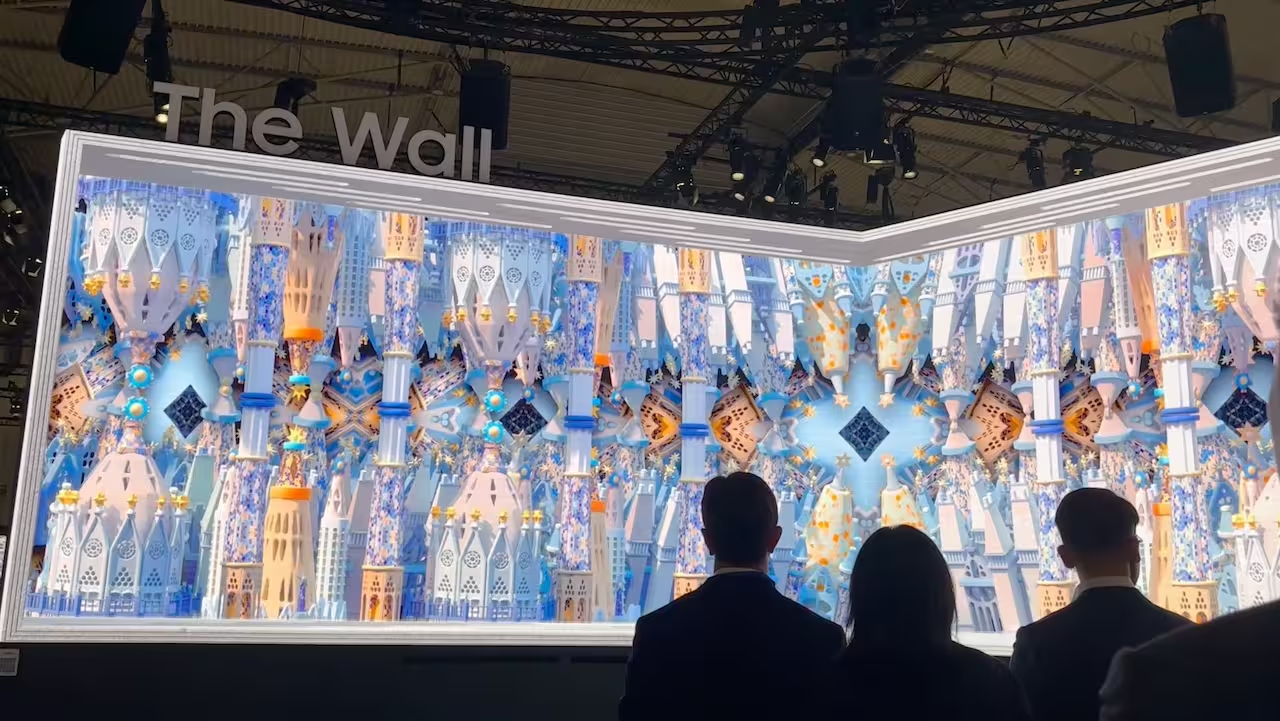
Think modular LED cabinets that you can arrange into displays of any size or shape. We're talking extreme brightness and flexibility here.
Reasons to consider:
- Scale to any size—10 feet to 100+ feet, whatever you need
- Incredibly bright (2,500-5,000+ nits) for any lighting condition
- Zero burn-in concerns since LED technology doesn't have this problem
- Modular serviceability means you swap out individual panels without taking the whole wall offline
- Available in both indoor and outdoor-rated versions
- At larger sizes, lower cost per square foot than individual displays
Where They Make Sense:
- Retail storefronts needing large-scale, high-impact displays
- Outdoor advertising and building facades
- Sports arenas, concert venues, entertainment spaces
- Corporate lobbies and large-format brand installations
Cost Reality:
- Indoor LED wall (P2.5mm): $150-$300 per square foot
- Outdoor LED wall (P6mm): $80-$150 per square foot
High-Brightness Commercial LCDs
Commercial-grade LCDs are built for 16/24-hour daily operation with brightness ratings of 700-2,500+ nits.
- Proven to run 24/7 with lifespans of 50,000-100,000 hours
- No burn-in issues whatsoever with static content
- Service networks are everywhere, and parts are readily available
- Bright enough for sunlit environments
- Anti-glare and anti-reflective coatings improve visibility
- Work in portrait or landscape orientation
- Cheap: $800-$3,000 for a 65-inch commercial display
Perfect For:
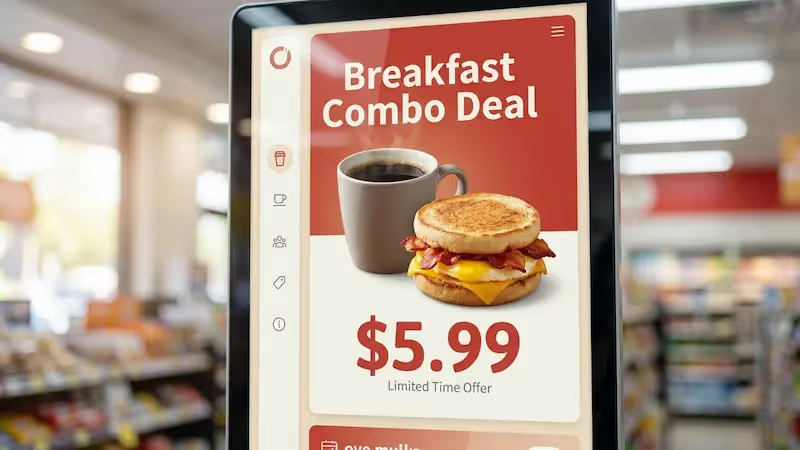
- Retail menu boards and product displays
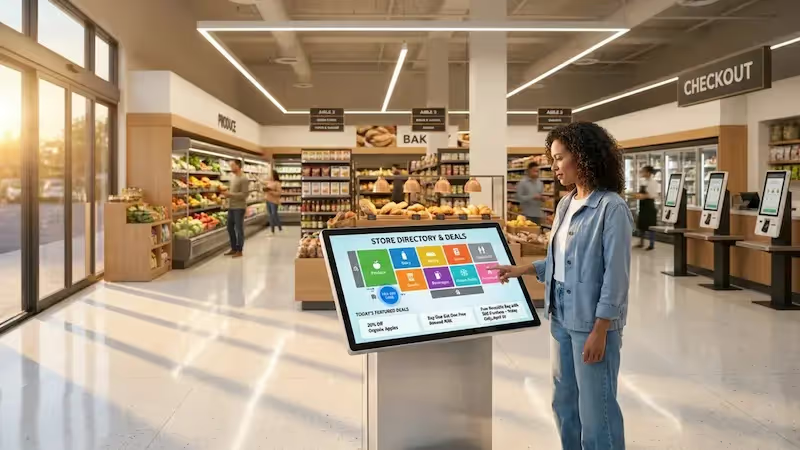
- Transportation wayfinding and information displays
- Corporate communications and employee engagement
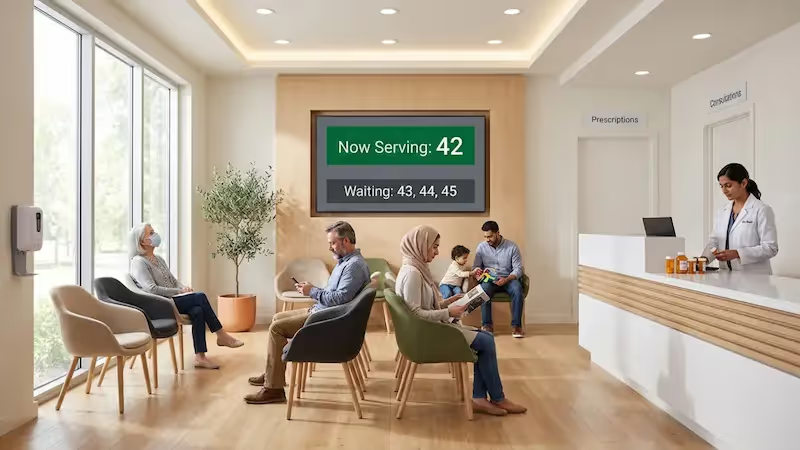
- Healthcare patient information and wayfinding
- QSR drive-thru menu boards
Curious about which displays would work for your use case? Check out specific models recommended by Look Experts
Ultra-Short Throw (UST) Projectors with Motorized Screens
Projectors positioned very close to the screen (inches away), creating large images, combined with motorized retractable screens.
Advantages:
- Largest screen sizes (100-150+ inches) at moderate costs
- Screen fully retracts into the ceiling for clean architectural aesthetics
- No burn-in concerns
- Projector lamp/bulb replacement is straightforward and economical
- Flexible aspect ratios and screen materials
Disadvantages:
- Requires controlled ambient lighting
- Regular lamp/laser module replacement (though modern laser projectors last 20,000+ hours)
- Not suitable for brightly lit retail environments
Use Cases:
- Corporate boardrooms and auditoriums
- Museum and gallery installations
- Premium residential home theaters
- Hospitality event spaces
Transparent OLED for Premium Applications
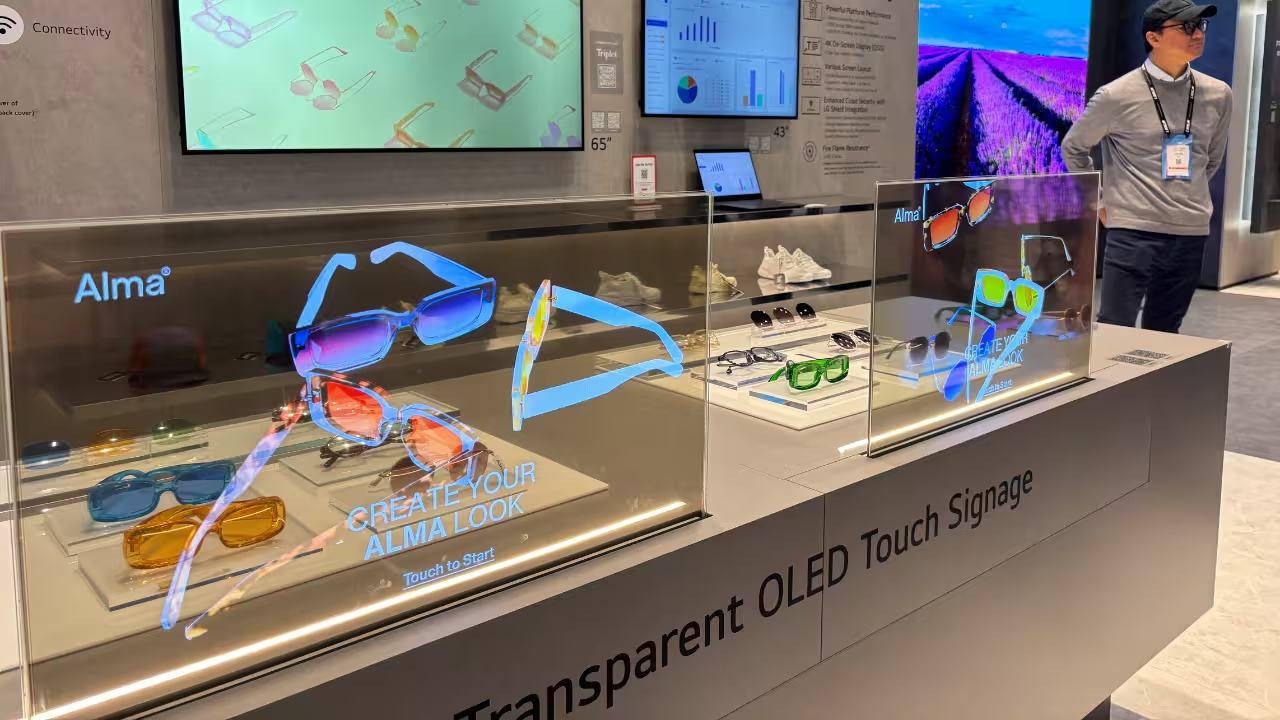
OLED displays with transparent pixels show content while remaining see-through when displaying black, allowing views of products or environments behind the screen.
Advantages:
- High-end aesthetic for luxury retail showcases
- Products remain visible behind the display
- Creates "floating" content effect
- Unique attention-grabbing format
Disadvantages:
- Still faces OLED burn-in concerns with static content
- Expensive ($10,000-$30,000+ for 55-inch transparent OLEDs)
- Limited brightness (ambient light significantly affects visibility)
- Requires careful content design to leverage transparency
Use Cases:
- Luxury retail product showcases (jewelry, watches, high-end fashion)
- Museum exhibit enhancements
- Corporate innovation centers and experience spaces
- High-end automotive showrooms
LG's Transparent OLED TV:
LG announced the Signature 77-Inch OLED T transparent TV at CES 2024, using some rolling mechanism technology from the OLED R. An opaque backing layer rises and lowers behind the transparent OLED pixels, solving ambient light problems while maintaining flexibility. Pricing sits at around $60,000.
Actionable Recommendations for Digital Signage Decision-Makers
Stick With What Works: Use high-brightness commercial LCDs, LED walls, or motorized lift systems. These technologies deliver proven, reliable performance.
Stay Away From OLED for Static Content: If your signage shows logos, menus, maps, or UI elements that sit on screen for hours, choose LCD or LED technologies. They don't burn in.
Match Technology to Your Environment:
- Bright spaces (retail storefronts, airports): High-brightness LCD (2,000-2,500+ nits) or LED walls
- Controlled lighting (corporate lobbies, museums): Standard commercial LCD, or OLED if your content is mostly video
- Outdoor: LED video walls only
- Need flexibility: Motorized lifts with standard displays
Do the Math on Total Cost of Ownership:
Factor in installation, energy consumption, maintenance, service contracts, and how often you'll need to replace things. Calculate what 5 years of ownership actually costs across different technologies. Include downtime costs when displays need service.
Invest in Content Management:
Whatever displays you choose, get solid digital signage software that gives you:
- Remote content management across all your locations
- Scheduling and content changes automatically
- Proof-of-play for advertising accountability
- Display monitoring to catch problems before they become outages
- Multi-zone layouts for flexible content

Plan for the Future:
- Install enough power and network connectivity that you can upgrade displays later
- Pick content management platforms that work with multiple display technologies
- Design mounts that let you swap displays without tearing up walls
If You're Monitoring Rollable Technology:
Maybe you're in luxury retail, run a museum, or operate premium hospitality spaces. If you think rollable displays might make sense once they mature, here's what to watch:
- Pricing: Wait for large-screen rollables to drop below $15,000-$20,000
- Automotive adoption: Car manufacturers proving rollable reliability might indicate they're ready for commercial signage
- Pilot first: Test in one flagship location before rolling out network-wide
- Stay flexible: Design installations where you can easily swap technologies as things evolve
Key Takeaways
- LG pioneered rollable TVs with the $100,000 Signature OLED R (2019-2024), proving technical feasibility but failing commercially due to extreme cost and limited practical value.
- Rollable technology is thriving in 2025 in laptops (Lenovo ThinkBook Plus G6 Rollable), upcoming smartphones (Samsung 12.4" rollable), and automotive displays (Visionox, BOE, Samsung)—applications where rollable functionality solves real problems
- Digital signage faces severe challenges: OLED burn-in with static content, insufficient brightness for commercial environments, astronomical costs, and uncertain reliability make rollables impractical for 95% of signage applications.
- Proven alternatives exist: Motorized lifts, LED walls, high-brightness commercial LCDs, and UST projectors with motorized screens deliver space efficiency, flexibility, and architectural integration at a fraction of the cost with superior reliability.
- As manufacturing scales and costs decrease, rollable displays could find applications in flagship retail showcases, museums, and premium hospitality.