
Table of Content
If you ask five digital signage vendors for a quote, it's entirely possible to get five wildly different numbers, ranging from a few hundred dollars for a single screen to tens of thousands for a multi-location rollout. And that's because digital signage isn't really a single product but a stack comprising displays, media players, software, mounting, installation, and ongoing content management, all of which come in a range of qualities and price points.
As you can imagine, this makes budgeting the hardest part of any signage project, especially if you're just starting. Spend too little, and you end up with a screen that looks washed out under store lighting or a player that struggles after a few months of daily use. Spend too much, and you've got an expensive system doing a job a far simpler setup could have handled just fine.
This guide will break down where the real cost of digital signage sits and show you how to plan a budget that suits your business.
All prices are indicative estimates in 2026 USD. The actual costs will depend on screen size, brand, location, reseller discounts, taxes, shipping, installation complexity, software features, and support needs.
How much does digital signage cost?
To answer this, it helps to split deployments into three tiers: basic, mid-tier (where the hardware needs to be reliable but not specialized), and heavy-duty setups for extreme weather or large-format displays like video walls.
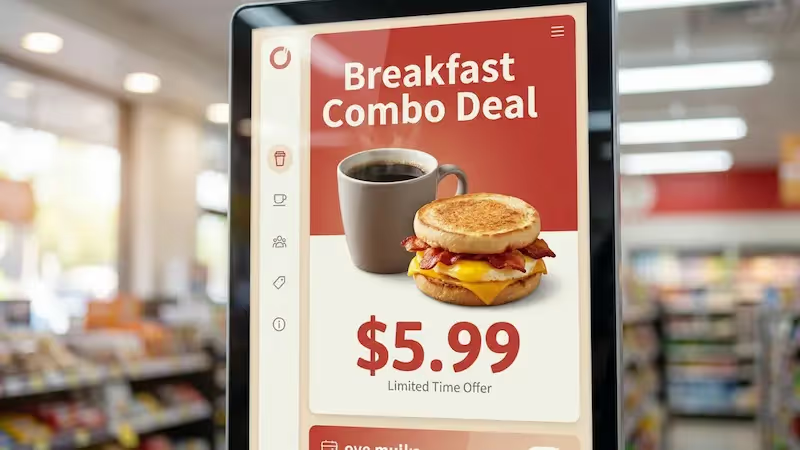
For lobbies, menu boards, announcements, and promotions that run only a few hours a day, you can use a consumer screen and a streaming device as a media player, which takes off a huge chunk of your initial investment. This can set you back around $300 to $500 for a regular TV, a Chromecast/Fire Stick/Raspberry Pi, basic cabling, and entry-level software.
But if you have multiple locations requiring 24/7 performance that are still indoors and climate-controlled, you'll need commercial-grade equipment, with a screen costing anywhere from $500 to $2,000 (this is the same price range as most SoC displays that come with a built-in media player). If you add in a proper media player, digital signage software, and mounting solutions, the full setup can land around $2,000 to $5,000 per screen.
For experiential retail, interactive experiences, video walls, or outdoor displays that can withstand direct sun, budget $4,000 to $25,000 per unit, once the enclosure, panel, and mounting are factored in.
A reliable commercial setup typically costs $1,200 to $2,000 or more per screen. This price includes a commercial display, a media player or a built-in smart display system, software, a mount, cabling, and basic installation.
Most hardware signage ranges from $8,000 to $20,000 or higher, but you're paying for weatherproof hardware, enclosures, electrical work, structural support, and permits.
For software, Look Digital Signage starts at $13.50 per screen per month on an annual plan. Volume pricing is available as you expand.
Here is a quick overview:
The cheapest screen isn't always the most affordable system. A low-cost display can end up costly if it breaks down frequently, is hard to operate, or doesn't work with the software and hours your business requires.
What influences digital signage cost?
As we said, there are many moving parts involved in a single signage deployment. Let's look at what you're most likely to encounter:
- Display type: consumer TV, commercial display, high-brightness screen, touch display, outdoor screen, kiosk, or video wall.
- Media player: Built-in smart display, Android player, Windows mini PC, professional signage player, Raspberry Pi, or dedicated Look Player.
- Software model: monthly subscription, annual subscription, on-premises license, perpetual license, or custom enterprise plan.
- Installation: Installation costs can range from a few hundred dollars for a basic wall mount to thousands for complex, high-altitude jobs or intricate multi-screen video wall alignments.
- Content: simple templates, branded graphics, videos, dashboards, menus, wayfinding, or interactive content.
- Support: standard support, premium support, service-level agreement, or dedicated enterprise assistance.
- Scale: one screen costs differently from 20, 100, or 1,000 screens.
- Integrations: POS systems, calendars, dashboards, APIs, inventory systems, or custom data feeds.
Digital signage hardware costs
Consumer-grade displays
A regular consumer TV is the absolute cheapest way to get your signage content live, which is why many businesses use them as entry points. A 43-inch regular TV may cost around $250 to $500, which is very appealing for basic indoor use in small businesses.
Consumer TVs can work for:
- Small cafes
- Local offices
- Waiting rooms
- Reception areas
- Temporary event signage
- Simple menus or announcements
Because they're built for home viewing, they lack heavy-duty internal cooling and high-brightness panels and can only operate for 6-8 hours a day. They're also limited to the landscape orientation, and extended use can shorten their lifespan and void the warranty. However, if you stick to a standard 9-to-5 operating window, keep the screens far away from glare-heavy windows, and don't mind physically walking over with a remote when you need to troubleshoot, they can be a massive budget-saver for basic signage.
Typical cost: $250–$700 per screen
Best for: Small indoor projects and testing digital signage
Main risk: Shorter lifespan and limited business-use warranty
Commercial-grade displays
If you decide to cross over to a commercial-grade panel, you are essentially paying for durability and an elevated brand experience.
The main thing you are buying here is thermal endurance. These screens feature heavy-duty cooling systems and commercial logic boards specifically engineered to run for 16 to 24 hours a day, year-round, without suffering from picture degradation or permanent image burn-in.
They also solve the massive headache of glare. While standard home TVs use glossy screens to make movies pop in a dark room, commercial displays use matte coatings and high-nit backlighting to cut through harsh overhead shop lights or bright window reflections. Add in helpful design perks like the ability to hang them vertically in portrait mode without cooking the internal components and physical lockouts that stop customers from tampering with the buttons, and it becomes clear why they are the industry standard for any serious rollout.
Typical cost: $600–$2,000+ per screen
Best for: Retail, restaurants, offices, schools, clinics, gyms, and lobbies
High-brightness displays
A normal TV or even a standard commercial screen will look completely blank the second the sun hits your storefront. To fight that, you need a high-brightness panel that pushes out 2,500 to 4,000 nits of light. For comparison, your living room TV is probably pushing a measly 300 nits.
And yes, these panels are expensive, sometimes three times the price of a standard display. But honestly, if nobody can actually read your window menu or see your promo because of the midday glare, your prime window space isn't really working for you. If you have a sunny window, this is the one area where you absolutely cannot afford to cheap out.
Typical cost: $1,500–$5,000+ per screen
Best for: Storefronts, bright retail, transportation, and window-facing signage
Outdoor displays
Outdoor digital signage costs a lot more than indoor signage. Outdoor screens require weatherproofing, high brightness, sealed enclosures, anti-vandal protection, temperature control, waterproof cabling, safe electrical work, and often permits.
A true outdoor display may cost several times as much as an indoor screen. Once installation, electrical work, structural support, and permits are added, outdoor signage can reach $8,000–$20,000+ per location.
Typical cost: $4,000–$10,000+ for outdoor-rated hardware; $8,000–$20,000+ installed
Best for: Drive-thrus, storefronts, gas stations, transit, parking, and outdoor advertising
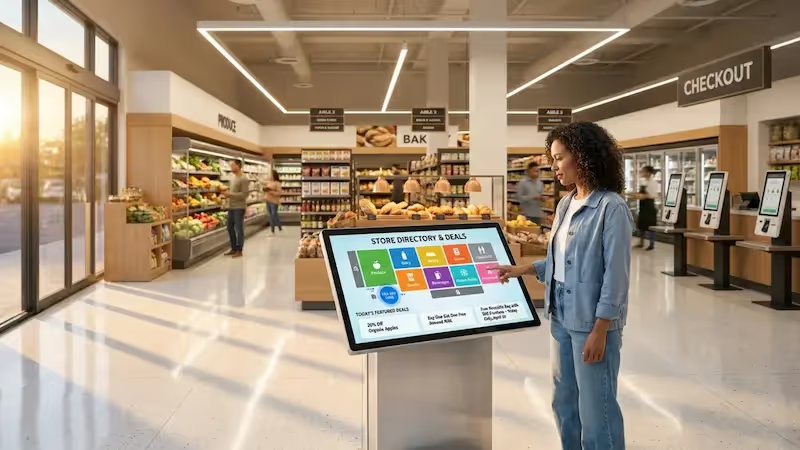
Interactive displays and kiosks
You can take a cheap shortcut by mounting an infrared touch overlay onto an existing screen for about $200 to $600. However, if you want the smooth, responsive feel of a modern smartphone, you need a dedicated commercial touch display. These run anywhere from $500 to $1,500, and the price rises quickly with screen size.
And let's not forget the physical enclosure. For a simple guest check-in desk, you can hang a touchscreen on a wall, which is straightforward enough, but you need freestanding steel kiosks that can survive in busy airports or high-traffic restaurant lobbies.
A basic indoor kiosk starts around $3,000. If you need to integrate with payment terminals and receipt printers, for example, a restaurant self-ordering setup, the price tag can easily climb to $5,000 or even $10,000 per unit. With these units, you are paying for steel fabrication, physical locks, and specialized labor to bolt them down and route power.
Typical cost: $1,400–$12,000+
Best for: Wayfinding, check-in, self-service, product catalogs, ordering, museums, and campuses
Video walls
Video walls either tile multiple thin-bezel LCD screens together or use seamless direct-view LED panels to build one giant screen.
The main challenge with a video wall is hiding the seams to maintain a uniform picture. Plugging a few screens into a cheap splitter won't exactly give you a clean result; you need a dedicated controller to slice up and distribute the high-resolution signage without lag or stretching. The physical setup is also incredibly precise and requires heavy-duty, micro-adjustable mounting brackets so installers can align the screens to the millimeter. If one panel is even slightly crooked or has a different color temperature than the rest, the illusion is completely ruined.
By the time you add up the controller, custom brackets, and hours spent color-matching every single screen, you're likely to spend north of $5,500 on hardware alone just for a basic 2x2 grid. And if you want a completely seamless direct-view LED wall, be prepared to incur upwards of $10, 000.
Typical cost: $5,000–$50,000+
Best for: Lobbies, control rooms, flagship retail, event venues, and arenas
Media player costs
A media player is the device that plays your digital signage content and sends it to the screen. Sometimes, it is a separate device connected by HDMI. Other times, it is built into the display.

You might not need an external player if your display has a built-in operating system, known as SoC or System on Chip. Many commercial smart displays can run digital signage software directly.
You may need an external player if:
- Your display’s built-in system is not supported.
- You need stronger playback performance.
- You need better offline playback.
- You need more storage.
- You need multi-screen synchronization.
- You need standardized hardware across many sites.
- You are running complex dashboards or interactive content.
Common media player options include:
Going for a cheap media player saves you money upfront, but it can easily come back to bite you if the hardware keeps crashing. If you are only setting up one or two screens, a basic, budget-friendly device is usually fine. But if you are managing screens across multiple locations, it's better to standardize the hardware. It makes troubleshooting much easier because your team doesn't have to guess which specific piece of hardware is acting up.
Player operating system as a cost factor
The operating system on your media player or screen is a major factor in your overall budget and long-term maintenance. It determines which apps you can actually run, how simple the setup process is, and how software updates are managed. It also plays a big part in how much ongoing technical support your team will need to provide.
Here is a look at how the most common platforms compare:
This matters because the cheapest operating system is not always the cheapest long-term choice. If a player is hard to update, overheats, loses connection, or cannot be managed remotely, support costs increase. For larger networks, it is usually better to choose a stable, supported platform and use it consistently.
Mounting and installation costs
Getting your new digital signage secured isn't always as simple as it seems. While you might get away with a basic wall mount for under $100, the reality is that your hardware needs can quickly become much more challenging. The moment you start looking at ceiling mounts, floor stands, specialized kiosk enclosures, or massive video wall setups, that price tag can easily vary from hundreds to thousands of dollars.
Bringing in professionals for installation covers a lot of ground.
A proper deployment includes a full site survey, structural mounting, cabling, electrical work, network setup, device pairing, system testing, and user training.
For a basic indoor installation, expect to spend between $250 and $500 for each screen. If you're dealing with a more complex location, that cost can easily climb to $500 or more. For really ambitious projects, such as outdoor displays, standalone kiosks, or large video walls, you will need to budget between $2,000 and well over $10,000.
Digital signage software costs
Digital signage software, also known as a CMS, allows you to upload content, schedule playlists, manage screens from a distance, check device status, use templates, assign users, and update screens all in one place.
Many digital signage software platforms today use a subscription model, with plans starting at $8 to $100 per screen. If you're just launching a small deployment, a seemingly cheap $7/screen or even some free tools might seem like a good deal, but it's worth thinking a few steps ahead. Most lower-priced plans cover only the basics, like simple content scheduling. As your needs grow to include live data, stronger security, or integrations with other software your business relies on, you might need to upgrade to a more expensive plan or switch to a different platform altogether.
That is why at Look Digital Signage, we give you full platform access starting at $13.50 per screen, with advanced security and premium features baked right in from day one, so you can scale your network without ever hitting a pricing wall. There are also volume pricing options.
Cloud vs on-premise digital signage software
Digital signage software usually comes in two main deployment models: cloud-hosted and on-premises.
Cloud-hosted CMS
Cloud-based digital signage is the most common model. The provider hosts the system, and your team manages screens using a browser. And you pay a monthly or annual subscription fee.
For most businesses, this is the easiest option to get started with because the setup is straightforward, updates happen automatically, and adding more screens or locations is usually as simple as your network grows.
Best for: Most small businesses, retailers, restaurants, offices, schools, healthcare, hospitality, and multi-location teams
Budget advantage: Predictable recurring cost and less IT overhead
On-premise CMS
On-premise digital signage operates on your own server or private setup. It is helpful for organizations that need strict control over data, compliance, security, or network isolation.
On-premise systems usually have higher upfront costs and require more IT support. You may need server infrastructure, backups, monitoring, security updates, and a support contract.
Best for: Government, banking, finance, healthcare, enterprise, and regulated environments
Budget advantage: More control over infrastructure and data
Budget risk: Higher setup complexity and internal IT costs
Software licensing models: subscription vs perpetual license
The license model has a significant impact on digital signage costs.
Subscription licensing
Most cloud platforms use subscription pricing. You pay either monthly or annually, often for each screen or player. This often includes hosting, updates, security patches, and support. Subscription pricing is easy to budget since it varies with your screen count.
Best for: Cloud CMS, growing networks, and businesses that prefer predictable OpEx
Watch for: Feature limits, storage limits, support limits, user limits, and API restrictions.
Perpetual or one-time licensing
Some on-premises or enterprise platforms offer perpetual licensing. You pay more upfront for the software license and might also pay an annual support or maintenance fee.
This can make sense for large or security-sensitive networks, but it is not automatically cheaper. You still need infrastructure, IT time, backups, upgrades, and internal support.
Best for: On-premise deployments, regulated industries, and large enterprise networks.
Watch for: Annual maintenance, server costs, upgrade fees, and IT labor.
Feature-tier pricing
If you already pay for subscription software, it's most likely only for the features you need, and if your requirements change, you upgrade. Digital signage software works the same way: the basic tier is usually enough for simple playlists and content scheduling. If you want data integrations, user permissions, detailed analytics, or enterprise-grade security, you'll almost certainly need to upgrade.
So, before you begin comparing prices, take time to think about where your signage project is headed. It's much easier and usually cheaper to choose a platform that can grow with your business than to migrate everything after outgrowing your current software.
RBAC, user roles, and access control
You can get away without RBAC when you're the only person managing your screens. That's rarely the case in a franchise, retail chain, hospital, or large corporate network, where marketing, IT, and local managers all need access, but not the same level of control.
Instead of giving everyone the same level of control, Role-Based Access Permissions let you tailor permissions to each role, which keeps things organized and reduces the chances of costly mistakes.
API and integration costs
Digital signage becomes more powerful when it connects to live business data. But integrations can also increase cost.
Common integrations include:
- POS systems
- Inventory systems
- Google or Microsoft calendars
- BI dashboards
- Queue management
- Emergency alerts
- Room booking systems
- Weather and transit feeds
- Social media feeds
- HR tools
- IoT sensors
- Custom databases
Simple integrations may be included in your CMS. More complex integrations may require API access, paid add-ons, middleware, or custom development.
Before choosing software, ask:
- Is API access included?
- Are integrations native or custom?
- Is there an extra charge for data feeds?
- Can the CMS securely display live dashboards?
- Who maintains the integration if something breaks?
API and integration costs can be overlooked, particularly in large deployments. If your signage relies on live data, be sure to include the costs for setup and maintenance in your budget.
Content creation costs
Content makes digital signage effective. Without good content, even the best screen won't produce results. Content costs depend on quality, format, and how often it gets updated.
DIY content
Many small businesses use templates, images, simple videos, menu layouts, and built-in apps. This can keep content costs very low.
Typical cost: Free to $50/month for design tools or stock assets
Best for: Menus, announcements, promotions, schedules, and basic internal communications
Freelancer or designer-created content
You can opt to hire a freelancer if you need professional-looking content without bringing on a full-time designer. Most businesses use freelancers for campaign graphics, menu boards, promotional videos, or seasonal content.
One way to keep these costs down is to use software that comes with professionally designed templates. Look Digital Signage, for example, includes a library of ready-made templates you can customize in minutes, which saves you both time and money when you need a new promotion or announcement.
Typical cost: $15–$25+/hour for basic freelance work; more for experienced designers
Best for: Retail campaigns, seasonal promotions, branded templates, and marketing screens
Agency or production content
If your screens are part of a larger marketing strategy, it might be better to hire an agency. They will handle everything from campaign concepts and motion graphics to video production, 3D animation, and custom content designed for LED video walls. Some of the most outstanding digital signage campaigns, such as Coca-Cola's interactive billboards and Samsung's spectacular LED installations, have a team of creatives behind them.
Typical cost: $500–$5,000+ per content package
Best for: Flagship retail, hospitality, corporate lobbies, events, and brand campaigns
However, you don't want to drain your entire budget on launch content. For digital signage content to remain valuable, it needs regular updates and continuous maintenance.
Hidden digital signage costs
Many signage projects go over budget because they overlook hidden costs early on.
Common hidden costs include:
Cabling
Basic HDMI and power cables may be cheap. However, long runs, in-wall cabling, Ethernet, conduit, cable raceways, or weatherproof cabling can increase costs.
Typical cost: $25 to $100+ per screen
Electrical work
With some installations, you can easily plug into an existing outlet and be up and running in a matter of hours. With others, however, you need new outlets, dedicated circuits, GFCI protection, outdoor-rated wiring, or even trenching to bring power to freestanding displays.
Indoor installations are usually the least expensive, while outdoor kiosks, drive-thrus, and digital billboards often require far more electrical work.
Typical cost: $500 to $2,000+
Network setup
Digital signage might need Ethernet, Wi-Fi, cellular routers, SIM cards, access points, firewall configuration, VPN access, or secure network policies.
Permits
If you're keeping your screens indoors, you can usually skip the red tape. But anything facing the street, especially if it's illuminated, oversized, or attached to a building facade, requires formal city or county approval. Local cities and zoning boards have strict rules on digital signs because they worry about distracting drivers or causing light pollution.
Typical cost: $0 to $2,500+, depending on location and sign type
Enclosures
A proper outdoor enclosure is actually a complex, climate-controlled environment. It requires active ventilation, heating, and cooling components to prevent the hardware from freezing in winter or overheating in direct sunlight.
In high-traffic public spaces, physical security is just as critical. Without heavy-duty locks and impact-resistant, anti-vandal glass, your display is incredibly vulnerable to theft and damage.
Typical cost: $500 to $3,500+
Energy
You won't usually break the bank on power bills for basic indoor screens. Still, electricity can definitely become a factor if you’re running large video walls or high-brightness outdoor displays.
If you are running your screens 24/7, those costs will naturally climb. However, you can manage this by using smart features like automated scheduling to turn screens off during off-hours, or by using ambient light sensors to dim your displays automatically when it gets dark outside. These simple adjustments not only help your bottom line but also extend the lifespan of your hardware.
Maintenance, support, and SLA costs
Buying the screens is only half the battle; to keep the signage system running smoothly, you also need to budget for maintenance, including replacing broken parts, fixing cables, cleaning screens, checking ventilation, updating software, resolving network issues, and sending technicians when needed. Annual maintenance usually costs between $100 and $500 per screen, depending on hardware complexity and the environment. Outdoor systems often need more maintenance than indoor screens.
Software support may be included in your subscription, but the quality of support varies. Basic plans may include documentation and email support. Enterprise plans may include onboarding, faster response times, dedicated support, and account management.

If your screens are driving sales or showing critical information such as menus or wayfinding maps, investing in a Service Level Agreement (SLA) is a smart way to guarantee quick response times and keep downtime from hurting your bottom line. At Look DS, we back our service with a guaranteed 99.9% uptime SLA, so you get reliable, cloud-hosted performance and responsive support baked right into your plan from day one.
Digital signage costs by business size
Small business: 1–5 screens
A small business setup might be used in a cafe, boutique, local restaurant, gym, dental office, church, or small office.
Best approach: Keep your setup simple by using templates and upgrade to commercial hardware only when the screen becomes important to daily operations.
Medium business: 10–50 screens
This includes regional retailers, restaurant groups, school districts, healthcare networks, hotels, offices, and fitness chains.
Best approach: We recommend standardizing your hardware and managing it through a single central CMS. Also, set up user permissions to easily delegate the work, use templates to save design time, and monitor your screens and content remotely.
Enterprise: 100+ screens
Enterprise signage includes national chains, universities, airports, hospitals, banks, manufacturers, and large corporate networks.
Best approach: At this scale, it helps to define your governance, approvals, security and integrations, SLAs, and hardware standards before rollout.
How to reduce digital signage cost
The goal is not to buy the cheapest system but to avoid unnecessary costs while maintaining network reliability.
Here are practical ways to reduce cost:
- Start with the use case. Do not buy hardware before deciding what the screen must do.
- Use existing screens when appropriate. This works for simple indoor signage.
- Choose commercial displays for business-critical screens. They cost more upfront but reduce the risk of downtime.
- Standardize media players. Mixed hardware creates support problems.
- Use built-in smart display systems when possible. This can remove the need for external players.
- Compare real software plans. Oftentimes, cheap plans don't allow multiple users, API integrations that connect your business tools, 24/7 support, or even analytics.
- Use templates. Templates reduce design costs and maintain branding consistency.
- Plan content refresh. A screen that never changes loses value.
- Install during renovations. Adding power and cabling during other site work is cheaper than retrofitting.
- Monitor screens remotely. Remote monitoring reduces unnecessary site visits.
Is digital signage worth the cost?
Digital signage is worth the cost when it improves communication, reduces manual work, increases sales, or enhances the customer or employee experience.
ROI varies depending on how digital signage is used. In retail stores and restaurants, it can increase sales by displaying the right products at the right time, speeding up menu updates, promoting upsells, and reducing printing costs. For corporate teams, the benefits usually include clearer internal communication, faster updates across the company, stronger safety messaging, and fewer emails.
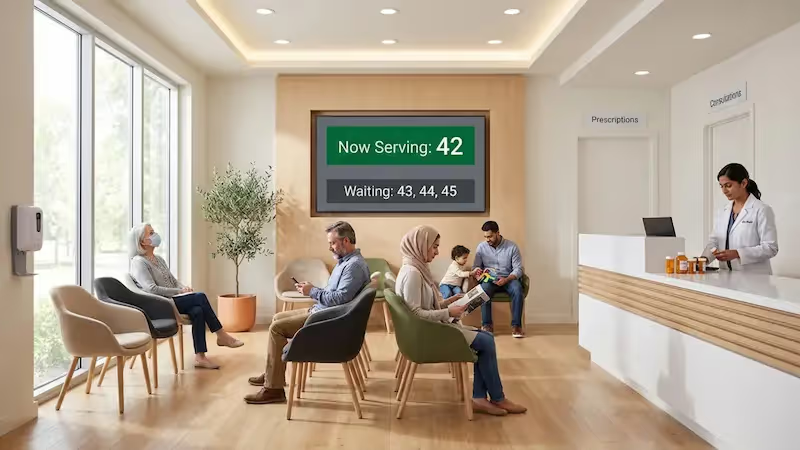
In healthcare and education, digital screens make navigation easier, waiting rooms less frustrating, and ensure you can instantly trigger emergency announcements across an entire campus. For advertising networks, ROI usually involves ad revenue, proof-of-play tracking, and the ability to schedule campaigns more flexibly.
In the end, digital signage delivers the most value when the content is timely, relevant, and simple to update.
Digital signage budget checklist
Before approving a project, confirm these items:
- Display type and size
- Indoor, window-facing, or outdoor environment
- Brightness requirements
- Operating hours
- Built-in SoC or external media player
- Player operating system
- Mounting hardware
- Cabling and cable routing
- Electrical work
- Network setup
- Permits
- Enclosures
- Software license model
- Monthly or annual subscription cost
- Cloud or on-premise deployment
- User roles and approvals
- API and integration requirements
- Content creation budget
- Content refresh schedule
- Support level
- SLA requirements
- Warranty
- Replacement plan
- Staff training
- Rollout schedule
If a vendor quote does not separate these costs, ask for a detailed breakdown. It will make the comparison much easier.
Maximize your investment with Look Digital Signage.
Your choice of digital signage software has a major impact on total cost. It dictates how easily your team can update content, schedule campaigns, monitor screens, manage users, and keep the network running smoothly.
At Look Digital Signage, our goal is to provide you with a solution that helps you manage these costs while giving your team the tools they need to grow. You can start with just one screen, reuse compatible hardware you already have, or go with our dedicated Look Players for a completely simple setup.
The Look CMS makes it easy to:
- Manage screens remotely from one CMS
- Schedule content by time, date, and location
- Use templates and apps to reduce content costs
- Monitor screen status and playback health
- Rely on offline playback so your screens never go blank if the internet drops.
- Manage a variety of supported operating systems all in one place.
- Scale from one screen to hundreds
- Choose cloud deployment or discuss on-premises options
- Get custom quotes for volume pricing, specific SLA needs, or full enterprise deployments.
If you already have TVs, media players, or commercial displays, there is a good chance we can help you reuse them to cut your upfront costs drastically. If you're starting completely from scratch, we always recommend beginning with the screens that have the clearest business case, measuring your results, and then expanding from there.
Start a free Look Digital Signage trial or contact the Look team to estimate the best setup for your business.
FAQ: Digital Signage Cost
How much does digital signage cost per screen?
Most standard digital signage setups cost between $1,000 and $5,000 per screen when you include hardware, software, media player, mounting, installation, and basic setup. DIY setups can cost less, while outdoor displays, kiosks, and video walls can cost much more.
What is the cheapest digital signage setup?
If you are trying to keep your upfront costs as low as possible, the most budget-friendly setup usually consists of a standard consumer TV, an affordable media plug-in like an Amazon Fire Stick or a basic Android box, standard cables, and a simple software plan. You can typically get a single screen up and running for around $300 to $500 total.
Will a regular TV work for digital signage?
Yes, you can. A regular TV can definitely work for small, indoor projects. However, commercial displays are much more reliable for long operating hours, customer-facing screens, and important business messages.
How much does digital signage software cost?
When evaluating cloud-based digital signage software, you can expect standard platforms to start at around $10 to $20 per screen per month, which is exactly where our own plans at Look sit. Plus, with Look, you get the added advantage of volume discounts, meaning your cost per screen drops as you add more displays to your network. However, if you require more advanced platforms or enterprise-level plans, you can expect them to cost between $50 and $100 per screen per month, depending on your specific needs for features, support, integrations, and security.
Do I need a media player?
It's not always necessary. Plenty of modern smart TVs and commercial screens can run your signage software directly. It's only required if you are dealing with heavy video files, trying to connect to an older TV, or just want the peace of mind that comes with rock-solid offline playback if your internet drops.
Why is outdoor digital signage more expensive?
Outdoor signage requires weatherproof hardware, high brightness, protective enclosures, safe electrical work, temperature control, vandal protection, and permits. These requirements make outdoor signage much more expensive than indoor signage.
What hidden costs should I budget for?
You will definitely want to set aside some budget for the physical setup, which usually includes running cables, hiring an electrician, making sure your walls have proper structural support, and occasionally even pulling permits or buying protective enclosures.
On the tech side, you have to factor in bringing the network online, as well as any additional software features or custom API integrations your team might request. You also need to budget for the occasional service call if a screen goes down, and decide who is responsible for creating and managing the content.
Is digital signage cheaper than printed signage?
It really depends on your timeline, but the short answer is yes, eventually.
When you first get started, digital signage definitely has a higher upfront cost. You have to buy the screens, media players, and cover the software subscription. A printed poster or a static menu board will always be cheaper on day one.
However, digital completely flips the script with your ongoing expenses. With print, you had to incur design fees, printing costs, shipping, and the manual labor of taking down the old signs and hanging new ones. With a digital setup, those updates cost you nothing but a few clicks in your CMS.